 Staff4dshire Scaffolding
Scaffolding for Solar Panel Installation: What to Expect
How scaffolding is used for solar panel installs on homes and businesses in Staffordshire, how long it stays up and how to prepare your property.

It is one of the first questions homeowners ask when they need a roofer: does it really need a scaffold? The honest answer is that most work at roof level is safer, quicker and better done from a scaffold. This guide explains why, the main types of scaffold used for roof work, and what to expect when one goes up on your home.
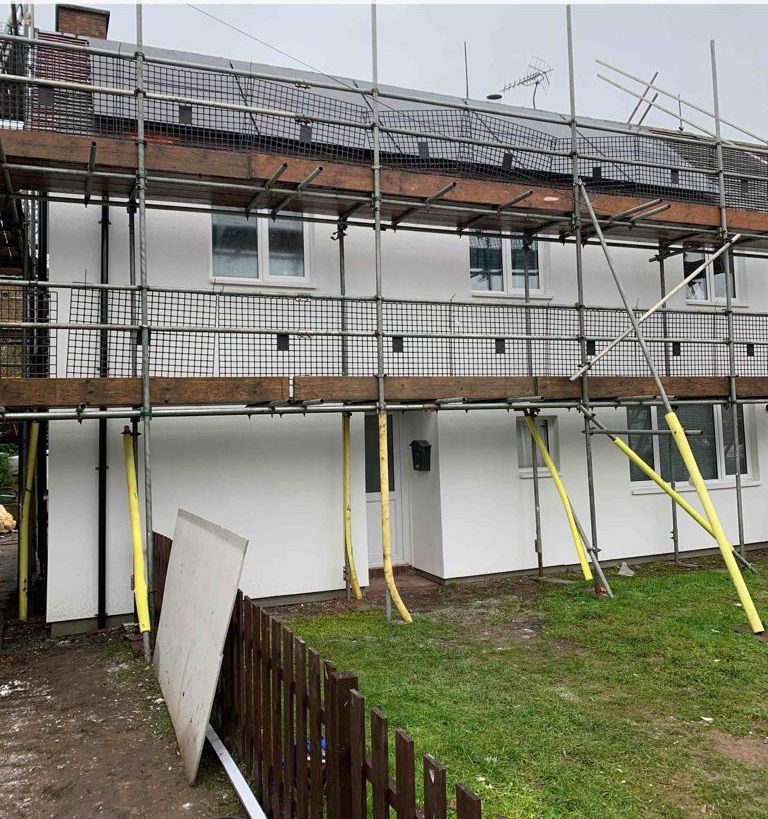
Working at height is one of the biggest causes of serious injury in construction, and the law expects work at height to be properly planned, with the right equipment chosen to prevent falls. For most roof repairs, from replacing slipped tiles to renewing lead around a chimney, a scaffold gives a stable working platform with guard rails, somewhere to put materials and safe access for the roofer.
It also means a better job. A roofer standing on a solid platform can strip, repair and detail properly instead of stretching from a ladder.
For a full re-roof or work along the length of a roof, an elevation or wrap-around scaffold is common, running along one or more sides of the house at eaves level with edge protection. For chimney repairs, a chimney scaffold provides a platform around the stack itself, usually tied in to an access scaffold below. For gutters, fascias and soffits, an eaves-level scaffold along the relevant elevation is usually enough.
The right design depends on the property, the ground, neighbours, and what work is being carried out. Our scaffolding and roofing teams work together, so the scaffold is designed around the job.
Some small, low-level jobs can be done safely from other access equipment, and for some inspections a drone or a camera on a pole can help. But if the work involves stripping, lifting materials or working at the roof edge, a scaffold is usually the right answer. If someone offers to do significant roof work from a ladder, it is worth asking how they will do it safely.
A scaffold should be erected by trained scaffolders, and inspected by a competent person before it is first used, after any alteration or event that could affect it (such as high winds), and at regular intervals while it is in use. Keep children and pets away from it, do not let anyone alter it except the scaffolders, and tell us straight away if you see anything that looks damaged.
Sometimes a scaffold needs to go on a neighbour's land or on the pavement. Neighbours' permission is needed for their land, and scaffolding on the public highway usually needs a licence from the local highways authority. We will flag this when we survey so it can be sorted before the start date.
Staff4dshire Scaffolding runs its own fleet of 3 flatbeds and 2 lorries, so materials are delivered and collected on time without relying on third-party transport. That matters when a roofer is waiting to start or you want the scaffold gone as soon as the job is finished.
Ask who is supplying the scaffold and whether it is designed for the work being done. A scaffold for re-pointing a chimney is different from one for stripping a whole roof slope, which needs loading bays and room to store tiles and battens. Check how long it is expected to stay up, whether there is a weekly hire charge if the job overruns, and who inspects it during the hire.
It is also worth asking how the scaffold will be secured out of hours. Ladders are normally removed or boarded off at the end of the day so the scaffold cannot be used as a way into the property. If neighbours' land is needed for access, agree that with them early rather than on the morning of erection.
Most homeowners are surprised how little a well-planned scaffold gets in the way. Make sure bins, cars and garden furniture are moved before the erection day, and keep children and pets away while the crew are working. Let the roofer know if you notice anything loose or damaged, and do not move ties, boards or guard rails yourself, even for a moment.
We scaffold for both housing and commercial projects across Rugeley, Lichfield, Cannock, Stafford, Tamworth, Birmingham and the West Midlands, and we work hand in hand with Staff4dshire Roofing Specialists.
As long as the roof work needs it. Because we use our own vehicles, we can strike it promptly once the work is signed off.
Yes. We scaffold for our own roofing company and for other trades.
Yes, we scaffold for both housing and commercial projects.
Staff4dshire ScaffoldingHow scaffolding is used for solar panel installs on homes and businesses in Staffordshire, how long it stays up and how to prepare your property.
 Staff4dshire Roofing Specialists
EPDM rubber, GRP fibreglass or torch-on felt? A practical guide to choosing a flat roof for garages, extensions and dormers in Staffordshire.
Staff4dshire Roofing SpecialistsDamp around a chimney breast? How lead flashings, back gutters, pointing and valleys cause most roof leaks, and how roofers in Staffordshire fix them.